
Teach, Earn, Own: A Community College Blueprint for the Regenerative AI Workforce
The Counter-Stack, volume three: the people
Infrastructure doesn’t run itself. The first post in this series laid out the economics of building profitable enterprises on open-source AI. The second borrowed Kevin Rudd’s statecraft to answer the geopolitics — how communities can use the best open models from anywhere, under red lines they enforce. This one answers the question every library director and county commissioner asks next: who is going to build, run, and fix all of this?
The answer has been sitting in plain sight, usually about fifteen minutes from your house: the community college. There are more than a thousand of them, they already hold the workforce development mission, they are trusted by the very institutions — libraries, municipalities, co-ops — that should own the nodes, and they know how to turn a regional employer’s need into a curriculum. What follows is a blueprint: the courses, the learn-and-earn model that pays students for real local projects, the funders and financing that make it durable, the beginning of an ROI case, and how the plan bends for rural versus urban colleges.
📚 The series so far: Volume one — The Counter-Stack (the economics, with Paul Krugman and Lina Khan). Volume two — May the Best System Win (the geopolitics, with Kevin Rudd). Volume three — the people: a workforce blueprint you can carry into a community college president’s office.
Why community colleges are the natural home
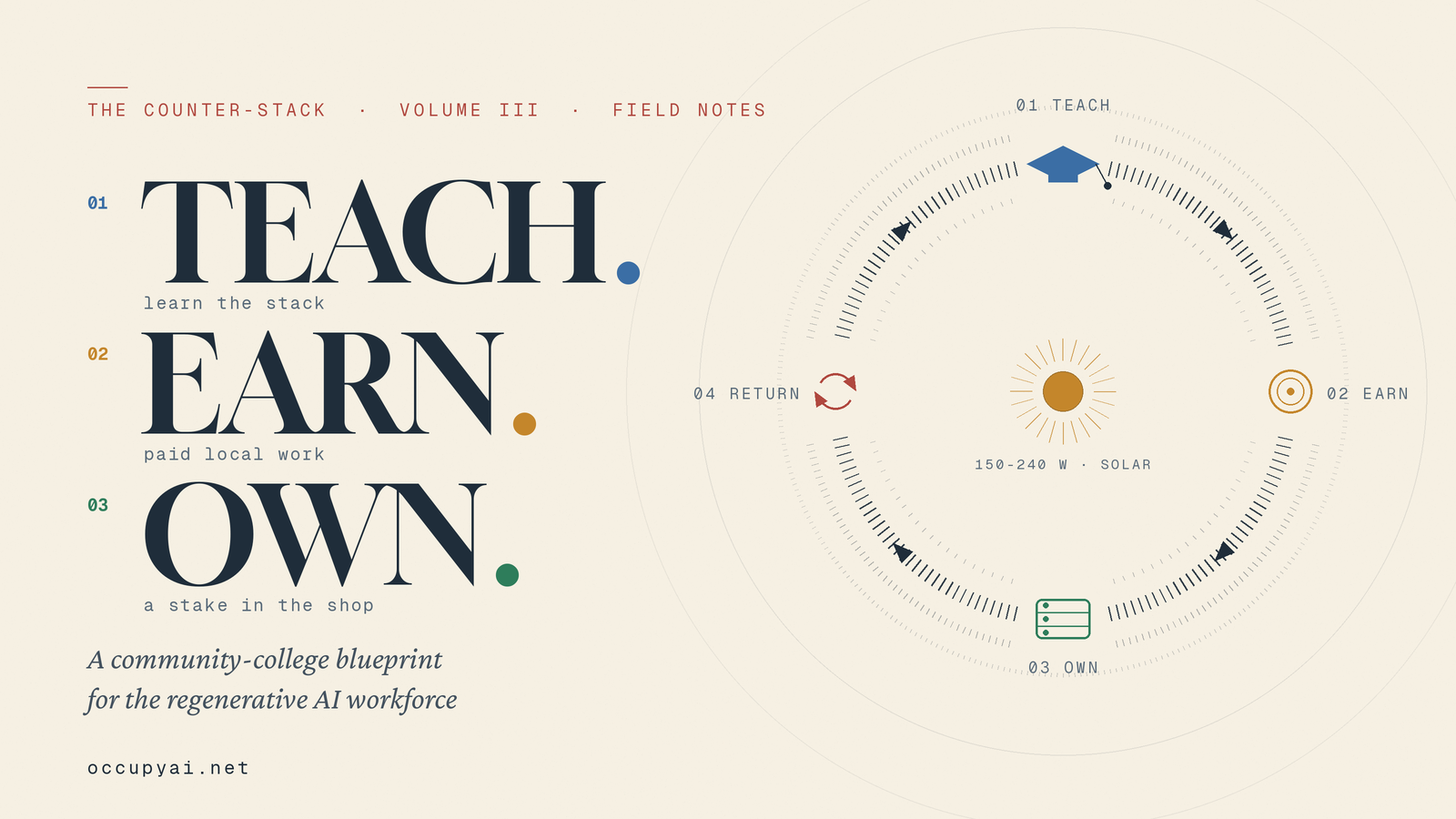
Community colleges are the last widely distributed, publicly owned, mission-driven institutions in American economic life. They are anchor institutions the way libraries are — and in many counties, they are the largest technical employer and the only postsecondary option within commuting distance. Their incentives point the right way: they are funded to produce local completions and local employment, not shareholder returns three time zones away. And they can play a double role no bootcamp can: the college hosts a solar-powered mini data center node on campus, and the node becomes the teaching hospital of the program — real infrastructure, serving real local clients, maintained by students who are paid for the work.
That teaching-hospital framing matters. Medicine solved this problem a century ago: you learn surgery in a working hospital, supervised, on real cases, and the hospital bills for the care. The counter-stack version is a teaching service bureau: students deliver AI services — document search for the historical society, a website agent for the hardware store, workflow automation for the food bank — under instructor supervision, and the program bills community rates for the work. Every course below is designed around that engine.
The catalog: core courses
Titles and taglines are written to recruit, because at a community college the catalog is the marketing. Descriptions are written so a curriculum committee can see the learning outcomes at a glance. Numbering follows a typical 100/200-level convention; adapt freely.
| Course | Tagline | Description |
|---|---|---|
| CAI 101 · Foundations of Community AI | Own the cloud beneath your feet | How modern AI actually works, what open-weight models are, and why architecture decides who holds power. Surveys the full counter-stack — models, nodes, solar, governance — with no prerequisites. Designed to satisfy a general-education technology requirement so every student on campus can take it. |
| CAI 110 · Solar & Power for Edge Compute | Size the array, tame the watts | Photovoltaic fundamentals, battery storage, load calculation, and thermal design for 150–240W compute nodes. Aligned with industry solar-installer credential pathways, so credits stack toward jobs that exist today even if a student never touches a model. |
| CAI 120 · Running Open-Weight Models | Weights, not services | Downloading, checksum-verifying, quantizing, and serving open models on modest hardware; version pinning; building small evaluation suites; documenting model behavior in plain language a client can read. |
| CAI 130 · Data Stewardship & Privacy for Civic AI | The librarian’s oath, upgraded | Public records law, privacy-by-design, and the red-lines framework from volume two: what may never leave the building. Capstone assignment: a model-use policy a real city council or library board can adopt as written. |
| CAI 140 · Economics of the Regenerative Stack | Rents versus roots | Techno-feudalism, platform rents, cooperatives, and community wealth building. Students map a real local economy, model where its dollars leak to distant platforms, and design one intervention to close the leak. |
| CAI 220 · WordPress + MCP for Main Street | Make 40% of the web agent-ready | The WordPress Abilities API and the Model Context Protocol as the connective tissue of a local marketplace. Students build and ship working connectors for actual area businesses — the plugin roadmap from volume one, as coursework. |
The catalog: paid lab and practicum courses
These are the project-based learning courses where work-study students earn wages for participating in real local deployments. Each one produces a deliverable a community actually keeps — a commissioned node, a live array, a working service. The 💰 mark means enrolled students in eligible placements are compensated through the learn-and-earn model described in the next section.
| Course | Tagline | Description |
|---|---|---|
| CAI 115L · Node Build Lab 💰 | From pallet to production in one semester | Teams assemble, image, and security-harden mini data center nodes, then commission one at a real host site — a library branch, rural clinic, or town hall — complete with documentation and a handoff ceremony the local paper can photograph. |
| CAI 125L · Solar Installation Practicum 💰 | Panels up, meter spinning backward | Field installation of the arrays that power the nodes, performed alongside local solar contractors who serve as adjunct instructors of record. Hours count toward installer credential requirements. |
| CAI 210L · Civic AI Services Practicum 💰 | Real clients, real deliverables | The teaching service bureau in operation: students scope, build, and deliver document search, website agents, and workflow automation for local nonprofits and small businesses, under supervision, on the campus node — never on a hyperscaler’s cloud. |
| CAI 230L · Model Evaluation Lab 💰 | Trust nothing, verify everything | Students run bias, safety, and censorship evaluations on newly released open models — Chinese, American, European — and publish the results openly so every community in the network benefits. Volume two’s “managed competition” as a lab science. |
| CAI 250L · Cooperative Capstone 💰 | Graduate owning a share of the shop | Student teams run the service co-op end to end — sales, delivery, bookkeeping, governance — and may convert logged equity hours into co-op membership at graduation. The exit isn’t a diploma and a job search; it’s a stake in a going concern. |
🎓 Don’t forget the non-credit side: two micro-credentials round out the catalog. AI for Main Street — a six-week evening certificate for business owners who will become the service bureau’s clients (and the program’s best advocates). Node Technician I — a stackable credential for incumbent workers, offered through the college’s continuing education arm, which can often launch in months rather than the year-plus a degree program takes to approve.
Learn and earn: how students get paid — and why businesses only pay a share
The compensation engine is not exotic. It is the Federal Work-Study program, which has quietly subsidized student wages since 1964 — plus its state-level cousins and, where those fall short, a philanthropy-funded mirror. The design insight is the cost share: a local business hosting a work-study student does not pay the full wage. Under federal rules, when a student works for a private for-profit employer, the federal share covers up to 50 percent of the wage — the business pays half. For nonprofits and government agencies, the federal share rises to 75 percent — the host pays a quarter. For nonprofits that genuinely can’t afford even that, the share can reach 90 percent, and for certain community-service roles like tutoring and family literacy, 100 percent.
| Placement type | Federal share (max) | What the host pays | Counter-stack example |
|---|---|---|---|
| Private for-profit business | 50% | ≥ 50% of wages | Local solar installer hosts a CAI 125L student on residential jobs |
| Nonprofit or government agency | 75% | 25% of wages | Library hosts a CAI 210L student building its document-search agent |
| Nonprofit unable to afford costs (limited slots) | 90% | 10% of wages | Rural food bank gets workflow automation it could never buy |
| Community service, tutoring, family literacy | 100% | 0% | Students teach AI for Main Street digital-literacy sessions at the senior center |
Shares per the Federal Student Aid Handbook; the 90 percent tier is capped at a small fraction of a school’s placements, and details change — the financial aid office is the authority.
Why this design is fair to everyone: the business gets supervised, instructor-backed technical work at half the market cost, plus first look at the graduates it will want to hire. The student gets paid — in money, not “exposure” — for work that becomes a portfolio and, in the capstone, an ownership stake. The community gets services delivered locally, on local infrastructure, at community rates. And the wage subsidy is not charity; it is the same public co-investment we’ve always made in teaching hospitals and agricultural extension, applied to the technology that will define the next economy.
Two patches close the gaps. First, not every student qualifies for Federal Work-Study, and allocations run out — so the program maintains a community work-study mirror fund, seeded by the philanthropy below, that pays the subsidy share for ineligible students under identical rules. Second, for students who want depth over breadth, the same placements can be structured as registered apprenticeships, which bring their own federal and state funding streams and give completers a nationally recognized credential.
Who funds this: the philanthropic map
Community college workforce development is one of the best-funded corners of American philanthropy right now, and community-owned infrastructure adds the climate and local-economy angles that unlock even more doors. The map, by funder type:
| Funder type | Examples | What to ask for |
|---|---|---|
| Postsecondary & workforce foundations | Ascendium (invested $39M+ in rural postsecondary and workforce training over five years), ECMC Foundation ($25–30M rural initiative), Lumina, Strada, Gates, Ballmer Group | Program design, guided-pathways integration, completion supports, evaluation |
| Place-based & community foundations | Your county or regional community foundation; legacy funders with hometown mandates (Kresge, Mott, and their regional peers) | The mirror fund for work-study wages; node capital for specific host sites they already love (the library!) |
| Climate & energy funders | Foundations and programs funding clean-energy workforce and community solar; utility-company charitable arms | Solar practicum equipment, instructor training, array capital |
| Civic & digital-equity funders | Library-sector funders, broadband/digital-inclusion programs, United Way affiliates | Community-service work-study slots (the 100% tier), digital-literacy micro-credentials |
| Corporate foundations | Tech and telecom giving arms — accepted with eyes open | Scholarships and equipment only; never the governance layer |
⚠️ Eyes open, per volume two: hyperscaler foundations fund community college AI programs, and their money is real. Apply Rudd’s lesson — believe what they say in public. If the grant agreement steers the curriculum toward their cloud, their certifications, and their APIs, it isn’t a gift; it’s customer acquisition. Take equipment and scholarships. Keep curriculum governance, model choice, and data policy in community hands, in writing.
Community investment: municipal bonds and their equivalents
Grants start programs; investment sustains them. Here the counter-stack borrows the oldest tool in American public finance. Community college districts already go to the municipal bond market routinely — education-sector muni debt has grown steadily, with community college borrowing up roughly 81 percent over a recent ten-year span — usually for buildings. The counter-stack proposal is to point a modest slice of that machinery at productive, revenue-generating infrastructure: nodes, arrays, and the teaching service bureau. The menu of instruments, roughly from most to least familiar:
| Instrument | How it works here | Best fit |
|---|---|---|
| General-obligation bond (college district) | Voter-approved; a workforce-infrastructure line item inside a larger facilities measure funds nodes, arrays, and lab build-out | Districts with bond capacity and a measure already planned |
| Revenue bond / lease financing | Debt serviced by the service bureau’s contract income and host-site fees rather than taxes | Programs with signed anchor clients (county, hospital, utility) |
| “Mini-bonds” sold to residents | Small-denomination municipal bonds (some cities have sold them in denominations as low as $500, residents-first) — your neighbors literally own the infrastructure’s debt and collect the interest | Communities with strong civic identity; doubles as organizing |
| Community investment notes via CDFIs | Impact notes offered through community development financial institutions fund node deployments; returns paid from service revenue | Urban areas with active CDFIs; mission investors |
| C-PACE financing | Commercial property-assessed clean energy pays for the solar array on the host building, repaid on the property tax bill | The solar layer, almost anywhere it’s enabled |
| USDA Community Facilities loans & grants | Federal financing for essential community facilities in rural areas — a node in a library or clinic qualifies as exactly that | Rural districts, population under ~20,000 |
| New Markets Tax Credits / pay-for-success | Credits attract private capital to facilities in low-income tracts; outcomes contracts pay when completion and placement targets are met | Larger urban builds with sophisticated partners |
Call all of this what it is: community investment. The same dollar behaves completely differently depending on which architecture it enters. Sent to a hyperscaler as a subscription or a subsidized electric bill, it makes one trip out of town and never returns — Varoufakis’s cloud rent, extracted. Invested in a node through a resident bond or a CDFI note, it cycles: it pays a student’s wage, which is spent at local businesses, which hire the service bureau, whose revenue services the bond, whose interest lands back in a neighbor’s account. That loop is what “regenerative” means in accounting terms rather than bumper-sticker terms.
⚖️ The usual caveat: this is strategy, not legal, tax, or investment advice. Bond counsel, the district’s financial advisor, and the state’s community college finance rules govern what’s actually possible in your jurisdiction — bring them in early, because the instruments above have real eligibility and disclosure requirements.
The beginning of an ROI
The baseline case for community college investment is already made: economic impact studies routinely find taxpayers recover between $1.60 and $6.80 for every public dollar invested, and students recover several dollars in lifetime earnings for every dollar they spend — California’s system recently reported roughly $13 back per student dollar. New Jersey’s community colleges alone support a $12.8 billion economic footprint. The counter-stack program should outperform those baselines for one structural reason: almost none of its spending leaks. The wages are local, the clients are local, the infrastructure is local, and even the debt service is local when residents hold the bonds.
Here is the beginning of a pro-forma for one campus node and one twelve-student cohort — deliberately conservative, explicitly illustrative, and meant to be replaced with your district’s real numbers in week one of planning:
| Line item (illustrative, year one) | Amount | Notes |
|---|---|---|
| Node + solar capital (amortized over 5 years) | ($6,000) | ~$30,000 installed, financed via C-PACE or bond proceeds |
| Program coordination & instruction share | ($45,000) | Partially grant-funded in years 1–3 |
| Student wage pool: 12 students × 10 hrs/wk × 30 wks × $18 | ($64,800) | Businesses and hosts pay ~$28,000 of this under the cost share; work-study and the mirror fund cover the rest |
| Service bureau revenue | $30,000 | ~12 community-rate projects; grows as the client base compounds |
| Local economic activity from wages | ~$100,000 | Student wages recirculate locally; standard multiplier assumptions |
| Avoided cloud subscription costs for host sites | $15,000+ | Library, clinic, and town hall AI services delivered on-node |
| Graduate earnings premium (12 completers) | compounding | The dominant long-run term in every published ROI study |
Read the shape, not the digits: modest, partially grant-covered operating costs; wage dollars that double as both training expense and local stimulus; service revenue that grows toward covering coordination; and a long-run earnings term that dwarfs everything else — which is precisely what the published studies find. Add the things a spreadsheet can’t hold: patron privacy that was never monetized, civic data that never left town, and a cohort of graduates with a reason to stay. A full ROI model — with sensitivity analysis and real district numbers — is a future post; consider this the opening entry in the ledger.
Rural and urban: same blueprint, different builds
The blueprint holds everywhere, but the load-bearing walls move. In rural districts the college is often the region’s anchor institution, period — sometimes its largest technical employer — so the college itself becomes the service bureau, and funders like Ascendium and ECMC have dedicated rural initiatives precisely because these institutions punch above their weight. In cities, the college is one node among many, and its advantage is convening power: a dense small-business client base, active CDFIs, and transit that makes evening cohorts viable.
| Dimension | Rural districts | Urban districts |
|---|---|---|
| College’s role | The anchor institution; runs the service bureau directly | Convener and neutral broker among many players |
| Employer cost-share base | Thinner; mirror fund and the 90–100% FWS tiers matter more | Dense small-business base can carry the 50% for-profit share |
| Capital sources | USDA Community Facilities, rural philanthropy initiatives, co-op utilities | CDFIs, community foundations, NMTC tracts, larger bond capacity |
| Connectivity | Node doubles as a resilience hub where broadband is thin — local AI that works offline is the killer feature | Bandwidth is plentiful; privacy and cost are the selling points |
| Solar | Land is abundant; ground-mount arrays can oversize for the grid | Rooftops and parking canopies; shared arrays across host sites |
| Logistics | Distance: hybrid labs, circulating node kits, block scheduling | Transit access enables evening and weekend cohorts |
| Talent story | Anti-brain-drain: paid local work plus co-op equity gives graduates a reason to stay | Differentiation: ownership stake beats the bootcamp’s placement promise |
One rural note deserves emphasis because it inverts the usual deficit story. Thin broadband — long treated as rural America’s disqualifying weakness for tech work — is an argument for this program, not against it. A node running open-weight models locally delivers modern AI capability that keeps working when the fiber doesn’t, which no hyperscaler product can promise. The communities the cloud economy wrote off are precisely the ones where locally owned intelligence is most valuable.
🌱 The invitation, volume three: we are looking for the first partner colleges — a rural district and an urban one — plus the trustees, deans, workforce boards, and financial aid officers who can move this from blog post to board agenda. We’ll bring the node hardware design, the curriculum drafts, the funder introductions, and the CivicBoxAI pilot experience; you bring the students and the community. If that’s you, start with volume one, then get in touch. The network needs your campus.
Further reading
- Federal Student Aid Handbook — the Federal Work-Study program (the cost-share rules, from the source)
- Lumina Foundation — Community Colleges and Workforce Development
- Ascendium — recent community college and sectoral training grants
- California Community Colleges — statewide economic impact study
- Education-sector municipal debt, explained
OccupyAI℠ is part of an ecosystem that includes the Broadband Institute Foundation, Verdant Data, and CivicBoxAI℠ from podCOINai℠ — building regenerative digital infrastructure: community-owned broadband, solar-powered mini data centers, and privacy-first AI.
Data Center Controversy
It is time for people to realize we have eco-friendly and profitable alternatives to hyper scale data centers. Please contact me if you would like helpful info.